

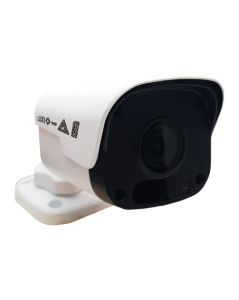
Because the object-detection algorithm is fully customisable, Luxio-AI is trained per product line — so the same system can sort very different goods, each against its own quality standard. The rejection logic is equally configurable: set the parameters that define a fail, and choose what happens when one is found.
How HEXA IoT implements it
From your factory floor to a running system
Luxio-AI isn't an off-the-shelf box you're left to configure. As an operator-proven provider, HEXA IoT implements it as a managed deployment — and the model is trained on your products, because no two lines look the same.
Assess the line
We study the product, the line speed, the defects that matter, and the physical constraints — then design the camera position, lighting and reject mechanism for that specific task.
Gather training images
We collect images of good product and the defects, contaminants and labelling errors you care about. The quality and range of this dataset is what determines real-world accuracy.
Train & validate the model
We train a custom object-detection model on your dataset and validate it against held-out images, tuning until it reliably separates good from bad under your line's real conditions.
Integrate with the line & Pandora
We connect the camera, edge unit and reject mechanism to your PLC, and wire the results into the Pandora platform for live monitoring, OEE and traceability.
Run, monitor & improve
As part of the managed service, we monitor performance and retrain the model as products, packaging or defects change — so accuracy doesn't drift over time.
Part of the Pandora platform
Every inspection becomes a traceable record
On its own, a vision system makes a pass/fail decision and moves on. Integrated with Pandora, Luxio-AI turns each decision into data — feeding the same dashboard that runs the rest of your floor, and connecting upward to your ERP, MES and SCADA.
CAPTURE
Camera + edge inference at the line
low latency · works offline
CAPTURE
PLC triggers reject / alert
configurable rejection logic
CAPTURE
Pandora logs result, image & time
pass rate · defect types · OEE
CAPTURE
Linked to batch / lot for traceability
audit & recall ready
CAPTURE
Up to ERP / MES / SCADA
via REST API · OPC UA
AT A GLANCE
Luxio-AI capabilities
CAPABILITY
DETAIL
Inspection type
Deep-learning object detection & classification — defect, contamination, labelling
Coverage
100% of production in real time (not sampling)
Training
Custom model per product line, trained on your good & defective images
Adaptability
Recognises products regardless of size, shape or position
Triggering
Sensor-triggered capture, synchronised to line motion
Compute
Edge inference at the line for low latency; cloud sync for monitoring
Rejection
Fully configurable parameters & reject mechanism (air-jet, arm, diverter) via PLC
Integration
Pandora platform; ERP / MES / SCADA via REST API & OPC UA
Records
Result, image & timestamp logged; linked to batch/lot for traceability & OEE
Delivery
Managed service — assessed, trained, integrated, monitored & retrained by HEXA IoT
Funding
Qualifies under SIRIM Smart Tech Up + 200% automation tax deduction
COMMON QUESTIONS
About implementing vision AI on your line
Do I need to know what defects to look for?
No — part of our assessment is identifying the defects, contaminants and labelling errors that matter on your line, then building the training set around them.
Will it work with my existing line and machines?
Yes. Luxio-AI is added to your line with its own camera, lighting and edge unit, and connects to your existing PLC and reject mechanisms — no need to replace equipment.
What happens when my product or packaging changes?
As part of the managed service, we retrain the model so it keeps recognising your current product accurately, rather than degrading over time.
Does it keep working if the internet goes down?
Yes — inference runs on an edge unit at the line, so inspection and rejection continue offline. Results sync to the cloud once connectivity returns.
How is this different from a normal camera or rule-based vision?
Rule-based systems only catch what they're explicitly programmed to see and break with small variations. Luxio-AI learns from examples, so it handles the natural variation of a real production line and can be trained for new products.